
Mining Pool Fees Explained: The Two Components Behind One Number
A payout from a mining pool is not one pile of money with one percentage taken out of it: it is a block-reward component and a transaction-fee component, and the listed fees attach to them separately. Under PPS+, the block-reward part is settled per share with a listed 4% fee while transaction fees follow PPLNS logic with a listed 2% fee; under PPLNS, both components are distributed together with a listed 2% fee. Reading those rates as a single 6% haircut is the most common arithmetic mistake in pool comparisons — and at 10 PH/s it is the difference between roughly $364.73 and a much lower number than the gross $379.93 the same hashrate earns in a day.

Key takeaways
- PPS+ uses a listed 4% on the PPS-settled block-reward component and a listed 2% on the transaction-fee component — the two rates act on different money, so they do not sum into 6% of income.
- PPLNS merges block rewards and transaction fees and distributes the total with a listed 2% fee, leaving the miner to carry reward variability.
- Settlement differs too: PPS+ pays hourly at current difficulty, while PPLNS settles after a block reaches 6 confirmations, weighted over the last 5 difficulty rounds.
- Scale makes the detail visible: at 1 PH/s the gross figure is about $37.99 a day, and the listed 4% would take roughly $1.52 of it if the whole payout were block reward — a useful upper bound, not the actual charge.
The core idea
Every block a pool finds contains two things of different origin. The block subsidy is protocol-issued and predictable — currently 3.125 BTC per block, which across 144 daily blocks means 450 BTC entering the network every day, about $38,111,400 at a BTC price of $84,692. Transaction fees are user-paid, vary with demand for block space, and can be a small or a large part of a block depending on the week.
Because those two streams behave differently, pools charge differently for them. PPS+ pays a theoretical amount for every valid share on the subsidy side and absorbs pool-luck and orphan risk, which justifies the higher listed rate there. It then distributes the fee-paid side with PPLNS logic at the lower listed rate. PPLNS applies one rule to both and charges the lower rate on the combined amount, while leaving the variability with the miner.
That structure explains the settlement calendar as well. Hourly payment at current difficulty mirrors PPS logic: a share is worth what the difficulty says it is worth, today. Payment after 6 confirmations across the last 5 difficulty rounds mirrors PPLNS logic: a share is worth what the pool actually earned during the window it belongs to.[1]
| Component | PPS+ (default) | PPLNS | Listed fee |
|---|---|---|---|
| Block subsidy | Settled per share at current difficulty | Distributed inside the combined pool | 4% under PPS+, 2% under PPLNS |
| Transaction fees | Distributed with PPLNS logic | Distributed inside the combined pool | 2% in both methods |
| Pool-luck and orphan risk | Carried by the pool | Carried by the miner | Reflected in the rate split |
| Settlement timing | Every hour | 6 confirmations, last 5 difficulty rounds | Not a fee item |
| Payout rail | Zero-fee mining payouts | Zero-fee mining payouts | Zero |
Two practical consequences follow. First, the blended rate you actually experience sits between the two listed rates and depends on how large the fee-paid component was in the window being measured. Second, comparing pools on a headline percentage is meaningless unless both sides say which component the percentage applies to — the fee-breakdown documentation exists precisely because that distinction keeps getting flattened.[2]
How it plays out at scale
Numbers make the distinction concrete. At 10 PH/s, gross daily output is 0.000449 BTC per PH/s times ten, or 0.00449 BTC — about $379.93 at $84,692. If every dollar of that were block reward, the listed 4% would remove about $15.20 a day, roughly $5,547 across a year. Because the transaction-fee component is paid at the lower listed rate, the real charge is less than that, and the difference widens in quiet fee environments.
Run the same arithmetic per terahash and the fee becomes portable across hardware generations. Gross income is about $0.038 per TH/s per day at current difficulty, so a hundred-machine hall at 1 PH/s collects roughly $37.99 daily before fees, and the size of the fee question is set by how much of that arrives as subsidy rather than as fees.
Where the choice of method does change the numbers is variance, and at scale variance is a financing cost rather than a psychological one. A PPLNS operation has to fund payroll, power and hosting through windows in which fewer blocks are found than its hashrate implies. That is why hourly settlement is more than a convenience feature: it converts an unpredictable annual total into a predictable hourly credit, which is what a treasury function can actually work with.
Two scenarios compared
Scenario one: 1 PH/s on PPS+
Daily gross 0.000449 BTC, about $37.99. Paid hourly, that is roughly 0.0000187 BTC — about $1.58 — every hour, 24 times a day, with the listed 4% applied to the PPS-settled block-reward component and the listed 2% to the transaction-fee component. Net of the 4% on the subsidy portion, the daily figure lands near $36.47. The cash-flow line is a staircase with 24 steps.
Scenario two: the same 1 PH/s on PPLNS
Identical hardware, identical share of network hashrate, identical gross expectation on average. The difference is that distributions arrive only when the pool finds blocks and passes 6 confirmations, measured across the last 5 difficulty rounds, with a listed 2% fee on the combined amount. Long-run averages can be a little higher and short windows can be a lot lower — the machine does not care, but the invoice does.
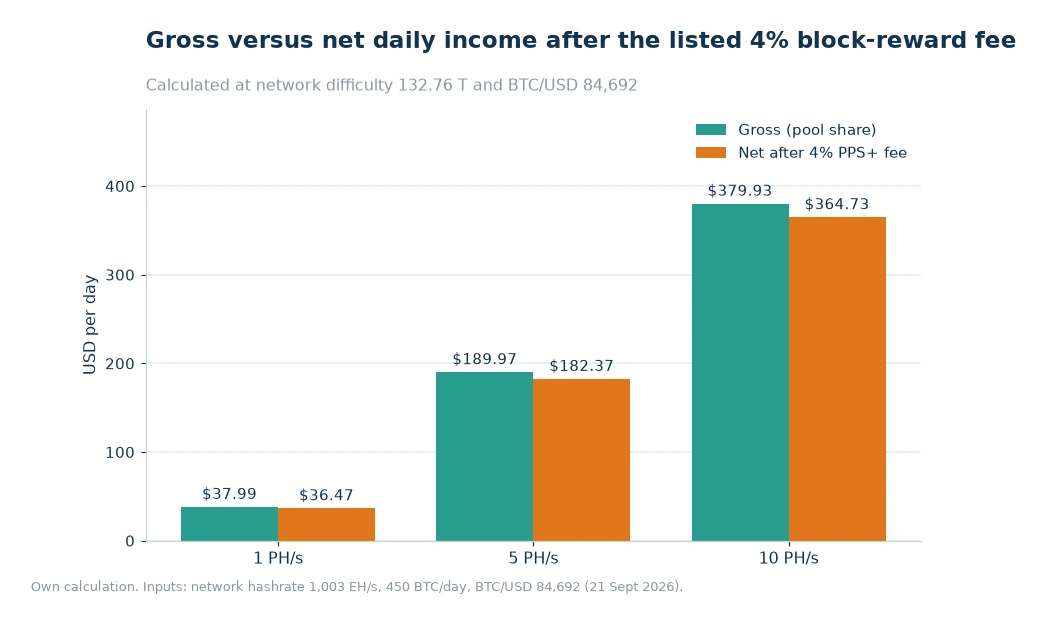
One more figure ties the scenarios to the real world. A 10 PH/s installation on 20 J/TH hardware draws about 200 kW, which is 4,800 kWh a day and roughly $288 at $0.06/kWh, against about $380 of gross daily income at current difficulty. The margin between those two numbers is thin enough that a fee misunderstanding of a few percentage points, repeated over a year, is worth more than most miners assume when they pick a pool from a headline rate.
Common failure modes
- Adding the rates together. A listed 4% and a listed 2% that apply to different components are not a 6% total charge, and treating them as one exaggerates the cost of the default method.
- Assuming the fee applies to gross income. The rate attaches to a specific component; the transaction-fee side is usually the smaller slice, so the effective charge on a payout is lower than the headline rate applied to everything.
- Comparing pools on fee alone. Uptime, latency to your region and payout cadence move more money than a fraction of a percentage point. A pool that settles hourly and never misses is worth more than one that saves 20 basis points and pays late.
- Ignoring the withdrawal leg. A fee schedule that looks cheap is undermined by costly transfers; zero-fee mining payouts and an integrated wallet remove that step rather than hiding it.
- Reading one quiet week as a fee problem. Under PPLNS a slow window is a variance event, not an error in the schedule. Check the statistics first, then the fee.
- Setting up without reading the chain-specific instructions. Stratum details, worker naming and payout thresholds differ per coin, and a misconfigured worker looks exactly like a fee problem from the outside. The mining pool dashboard shows per-worker hashrate, which is the fastest way to rule that out.
Before changing methods, model the change. The profit calculator takes coin price, difficulty, fee rate and effective hashrate and returns a daily estimate, including merged-mining output where a chain supports it, so the comparison is between two numbers rather than two marketing pages. If you are new to a chain, the ViaBTC Mining Guide collects the coin-specific setup steps for BTC, BCH, LTC and KAS and is the right starting point before you touch a fee setting.
Frequently asked questions
How often should a miner check pool statistics?
Weekly is enough for cash flow, daily if you are reconciling worker uptime or chasing a hashrate fault.
Does the payout method change my average income?
It changes the variance and the fee, not the underlying expected value: your share of network hashrate still sets the ceiling.
Which method should a new miner choose?
Start from the bill rather than the rate. If income has to cover fixed costs on a schedule, the hourly settlement of the default PPS+ method is easier to run against an electricity invoice; if the operation holds reserves and prefers the lower listed rate on a combined payout, PPLNS is the alternative.
Are pool fees the largest cost?
Usually not. Electricity is normally the bigger line, which is why the fee question should be settled after the hardware efficiency and tariff question.
Read the schedule, then the statement
Check which component each listed rate applies to, confirm how often payouts settle, and verify the withdrawal leg is free of charge. Then run a month of actual credits against the formula — hashrate divided by network hashrate, times 450 BTC per day, minus the applicable listed fee — and see whether the difference is explained by the components you were charged on. Before changing any setting, follow the chain-specific setup steps the pool publishes for BTC, BCH, LTC and KAS, because a misnamed worker and a misunderstood fee look identical in your first statement.[3] Difficulty and price move constantly, so repeat the exercise whenever either shifts; a fee schedule is a fixed document, but what it costs you is not.
Data and sources: listed fee rates, the component they attach to, and settlement rules are published on the ViaBTC pricing page[1]; the split between block rewards and transaction fees is explained in the fee-breakdown article[2]; network difficulty (132.76 T), network hashrate (about 1,003 EH/s), the 3.125 BTC block subsidy and BTC/USD 84,692 were read on 21 September 2026; coin-specific setup steps are in the support guide[3]. All income figures are own calculations from those inputs and change as difficulty, fee volume and price move.