
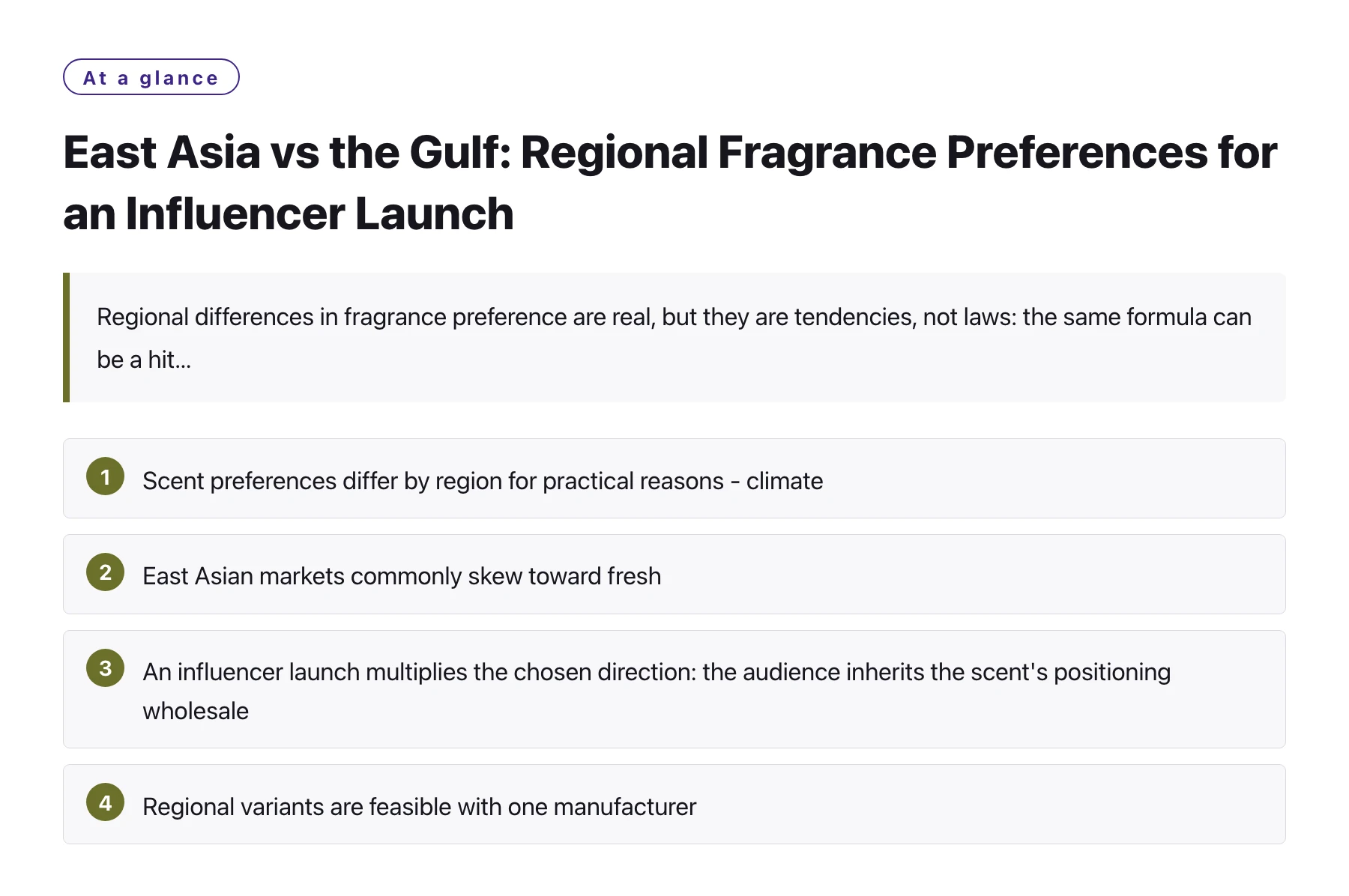
Regional differences in fragrance preference are real, but they are tendencies, not laws: the same formula can be a hit in one market and a politely ignored sample in another. For an influencer-led launch the honest options are two - choose one region and build for it, or build variants and test each - and the choice has to come before the scent, because influencers amplify whichever direction you pick.
Key takeaways
- Scent preferences differ by region for practical reasons - climate, habits of use, gifting culture - so a fragrance that wins in one market should be re-validated, not copied, in the next.
- East Asian markets commonly skew toward fresh, subtle, skin-close scents, while Gulf markets often reward intensity and longevity; the divergence shows up in concentration, family and bottle cues alike.
- An influencer launch multiplies the chosen direction: the audience inherits the scent's positioning wholesale, so the region decision must precede the scent decision.
- Regional variants are feasible with one manufacturer, but each variant adds its own samples, stability work and packaging documentation; the cost is predictable if planned up front.
Fragrance is the most personal product a brand can launch, and the most cultural one. What smells clean to one market smells sharp to another; what reads as luxury in one reads as heavy in the next. The people who buy through influencers trust the person first - which makes the cultural guess the part you cannot wing.
Market research treats fragrance as a live consumer category with its own reporting: houses such as Mintel publish dedicated fragrance and personal-care coverage rather than folding it into general beauty [1] - a reminder that scent decisions are observed, researched and measured like any other product decision.
The comparison below is deliberately broad: East Asia versus the Gulf, dimension by dimension. Treat it as a briefing tool, then validate with in-market testing - because the table is a map, not a verdict.
Why the differences are real
Climate does a lot of the work. In hot, humid markets a heavy fragrance competes with air conditioning and perspiration; in drier, milder climates a scent has an easier life on skin. But usage habits matter just as much: how much product people apply, when they apply it, who they buy for, and what they think a perfume is for.
Gifting is the sharpest cultural difference. In many Gulf markets fragrance is a gift given often and generously, which rewards presence, longevity and a bottle worth handing over. In much of East Asia the same product is often bought for oneself, used quietly, and chosen at a price point that suits regular repurchase.
None of this is a reason to stereotype a market; it is a reason to test. And when the testing says the regions genuinely diverge, the manufacturing question is whether one partner can carry both directions - a manufacturer offering Xuelei fragrance OEM/ODM can adapt a base for one market and develop something bespoke for another without the brand running two supply chains.
Region A versus Region B, dimension by dimension
| Dimension | East Asia (e.g. China, Korea, Japan) | The Gulf (e.g. UAE, Saudi Arabia) |
|---|---|---|
| Scent weight | Fresh, light, skin-close; subtle projection | Richer, denser; projection and presence valued |
| Characteristic families | Citrus, green, clean musk, light florals | Amber, oud, sweet resins, assertive florals |
| Longevity expectation | Longevity welcome, but subtlety wins | Hours-long wear is often the point |
| Weather and application | Humid urban climate; lighter application | Heat drives layering; stronger application norms |
| Gifting culture | Often self-purchase; regular repurchase | Frequent, generous gifting; the bottle matters |
| Influencer fit | Clean, daily-utility framing | Ceremony, occasion and gifting framing |
Read each row as a spectrum rather than a box. The value is seeing where the two briefs genuinely diverge - scent weight, family and framing - so a single-variant launch knows exactly which risk it is taking.
Building the launch around the answer
Once the region is chosen, the scent brief follows. For a single-region launch, spend the whole budget confirming that one direction: one hero scent, tested with the actual audience, launched with influencers who live in the market.
For a two-variant launch, contract the work before sampling: two briefs, two development tracks, two stability programmes and two label stories. The second variant stops being a 'small extra' the moment the regulator or the retailer asks for its file.
The manufacturer's breadth decides how heavy the variant plan really is. A partner whose range spans categories can move a fine fragrance into a scented body product for a launch kit without changing factory - the category list on www.xuelei.com/ runs from fine fragrance through home fragrance to scented body products, which is the sort of range a region-flexible campaign actually uses.
The influencer checklist
Pick the region before the scent
The influencer's audience is the market. A creator whose followers are in Seoul or Shanghai tests an East Asian direction better than any trend deck; a creator whose audience is in Dubai or Riyadh does the same for a Gulf direction.
Brief in the market's language
Use local terms for the scent's effect - clean, fresh, classic, bold - and let the creator translate the positioning, not the formula sheet.
Test with the actual audience
Send samples to a handful of their followers or run a pre-launch poll. The gap between what the brand thinks the scent means and what the audience smells is the biggest risk an influencer launch carries.
Keep one hero and one variant
A launch with one hero scent plus one regional variant stays manageable; each additional variant multiplies inventory risk, stability files and label versions faster than it multiplies reach.
Measure per region
Split the tracking by market from day one - sell-through, sampling-to-purchase, repeat orders - so the second generation of the launch is decided by data, not by the loudest comment.
Sources
- Mintel Press Centre —— Mintel's press releases on consumer and beauty market research, including fragrance and personal care trend reporting.
Frequently asked questions
Are fragrance preferences really that different between regions?
Enough to matter for a launch: the same scent can underperform in one market and overperform in another because of climate, habits and gifting culture. The differences are tendencies, not rules - which is exactly why testing in-market beats copying a formula.
Should I launch one scent or two regional variants?
Start with one hero if the budget is tight; two variants only when the regions are genuinely different and each has distribution waiting. A variant doubles development, stability and packaging work, so it should be a strategy, not an excuse.
How much extra does a second regional variant really cost?
The visible extra is a second development track and its samples; the hidden extras are a second stability programme, second labels and notifications, and double inventory risk. Budget for the whole set, and the number stops being a surprise at the first reorder.
Can influencers tell me which region to target?
Use them to reach a region, not to choose one. An influencer is distribution with a voice; the choice of market belongs to the brand's data - retail demand, cost of acquisition, and the scent's fit with local habits.
Do regional variants need separate packaging?
Not always, but the label content - ingredient lists, claims, language and any local compliance marks - is per-market regardless of whether the bottle changes. If the scent itself is different, the product is different, and the documentation should say so.